

2027-28 FAFSA Is Open! What Parents Need to Know Before Filling It Out
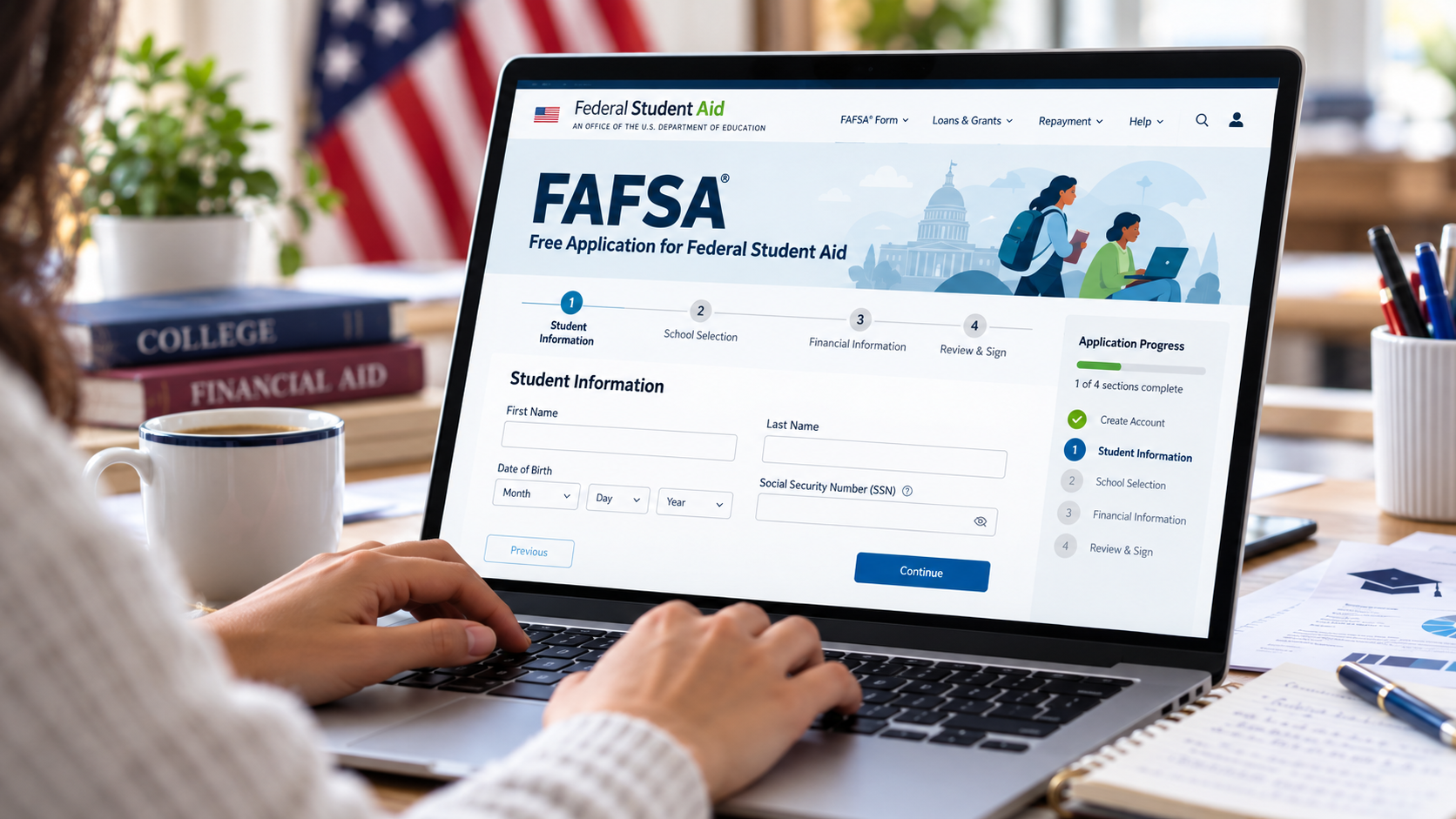
College is expensive. And for many families, figuring out how to pay for it can be just as stressful as the application process itself.
That’s where the FAFSA comes in.
The Free Application for Federal Student Aid (FAFSA) is one of the most important tools families have for understanding their financial aid options. Yet every year, families skip it because they assume they won’t qualify for assistance, don’t know where to begin, or find the process too confusing.
The 2027-28 FAFSA is now open. If your student plans to enter college in fall 2027, here’s what you need to know.
What Is the FAFSA, and Why Does It Matter?
The FAFSA is the form used to assess a family’s eligibility for federal financial aid. Using the information the family provides, the U.S. Department of Education processes the form to generate a Student Aid Index (SAI), which determines eligibility for several types of assistance, including:
- Grants: Money that generally doesn’t need to be repaid, including federal Pell Grants.
- Federal student loans: Loans that may offer more favorable repayment options than private loans.
- Work-study: Part-time employment opportunities funded by the federal government that allow eligible students to earn money while attending college.
- State and institutional aid: Grants and scholarships offered by states and colleges, some of which require the FAFSA.
- A note regarding merit scholarships: A few colleges require the FAFSA even for scholarships that aren’t based on financial need.
Each individual college where the family applied for need-based aid then uses the Student Aid Index to determine how to assemble the student’s financial aid package.
Completing the FAFSA doesn’t guarantee financial aid, but it may open doors your family hasn’t considered.
Should Every Family Complete the FAFSA?
One of the biggest misconceptions about the FAFSA is that families with higher incomes won’t qualify for financial aid. In fact, there’s no income cutoff that automatically disqualifies a family from federal student aid. Income matters, but it isn’t the only factor. Family size, assets, debts, and other financial circumstances can also affect eligibility. That doesn’t mean every family needs to file. If your family is unlikely to qualify for need-based aid and your student’s colleges don’t require the FAFSA for scholarships, it may not be necessary.
Our advice? Don’t assume. Find out.
Start with the Net Price Calculator (NPC) on each college’s website. Type in “Net Price Calculator” on the college’s search bar. Do not use Google to find a college’s Net Price Calculator.
The NPC offers an estimate of what your family might pay at that particular college after grants and scholarships. If you’re still unsure, contact the college’s financial aid office to find out whether completing the FAFSA makes sense for your family and whether it’s required for any institutional scholarships. Financial aid staff are happy to help prospective families.
How to Fill Out the 2027-28 FAFSA
The FAFSA is free and can be completed online at StudentAid.gov. Here’s how to get started.
1. Create your StudentAid.gov accounts.
Your student and any parent required to provide financial information must each have their own account. Have your student start the application, even if you’re helping with the process.
2. Gather your financial information.
For the 2027-28 FAFSA, you’ll generally need:
- Student’s Social Security number, if applicable
- 2025 tax information for parent/s and student
- Bank account balances and investment information
- Records of child support received and other reportable financial information, if applicable
Much of the required federal tax information can be transferred directly from the IRS, simplifying the process.
3. Complete the student and parent sections.
Your student will answer questions about personal information, dependency status, and finances. Any parent who is required to provide financial information will complete their own sections using their separate accounts.
If parents are divorced or separated, special rules determine which parent’s financial information must be reported. It isn’t necessarily the parent the student lives with most often. Generally, it’s the parent who provided more financial support during the previous 12 months.
4. Add your student’s colleges.
List the colleges your student is considering, even if they haven’t applied or been accepted. Schools can be added or changed later.
5. Review, sign, and submit.
Both the student and all required contributors must complete and sign their respective sections. After processing, you and your student can review the FAFSA Submission Summary to check for errors and see an estimate of federal aid eligibility.
ICC Tip: The FAFSA must be completed every year your student wants to receive financial aid. Don’t assume that filing freshman year covers all four years nor that the package your student receives in freshman year will be matched in subsequent years. This is an excellent question to ask the financial aid office.
What Is the Student Aid Index (SAI)?
Once the FAFSA is processed, your student will receive a Student Aid Index, or SAI. This number helps colleges determine eligibility for need-based financial aid.
Your SAI is not your college bill or necessarily what your family will pay. A lower SAI generally indicates greater financial need. The number can even be negative, as low as –1,500.
Colleges generally calculate financial need using this formula: Cost of Attendance minus Student Aid Index = Financial Need.
For example, if a college costs $70,000 annually and your student’s SAI is $30,000, the calculated financial need would be $40,000.
However, that doesn’t mean the college will automatically provide $40,000 in aid. Some colleges meet 100% demonstrated financial need, while others cover only a portion. And even colleges that meet 100% of need may include loans in their financial aid packages. When comparing offers, look beyond the total amount of assistance. Pay close attention to how much is grant money (this is gift money; it does not have to be paid back), how much must be borrowed, and what your family will have to pay out of pocket.
You can estimate your student’s SAI before filing the FAFSA using the Federal Student Aid Estimator.
FAFSA vs. CSS Profile: What’s the Difference?
In addition to the FAFSA, some colleges require a second financial aid form called the CSS Profile.
The CSS Profile, administered by the College Board, is used by certain colleges to determine eligibility for institutional aid (i.e., aid that comes from the college’s financial aid budget). The CSS Profile’s questions are more detailed than those on the FAFSA, and filing it generally requires a fee, although fee waivers are available. Some colleges require only the FAFSA, while others require both. Check each college’s financial aid website for specific requirements.
When Are the 2027-28 FAFSA and CSS Profile Deadlines?
As early as possible after the application opens (typically in October) for the academic year your student will enroll. You are typically filling out the FAFSA an entire year before your student is enrolled. In general, you want to file the FAFSA—and CSS Profile when applicable—no later than the deadline of your student’s application for admission.
Although the federal FAFSA deadline extends well beyond the start of the admissions cycle, colleges and states often have much earlier priority deadlines. Some financial aid programs have limited funding and may award assistance on a first-come, first-served basis.
ICC Tip: Keep track of financial aid deadlines alongside college application deadlines, especially if your student is applying Early Action or Early Decision.
What Happens After You Submit the FAFSA?
Once the FAFSA is processed, review the information for accuracy and watch your student’s college portals for requests for additional documents (access to the college’s portal will be sent by the college after the student submits their application for admission).
When financial aid offers arrive (typically along with the student’s notification of admission), compare them carefully. Examine how much assistance comes from grants and scholarships versus loans. Find out whether the aid is renewable and what conditions your student must meet to keep it. If your family’s financial circumstances have changed significantly since filling out the FAFSA, contact the college’s financial aid office. You may be eligible for a financial aid review.
Frequently Asked Questions About the 2027–28 FAFSA
Is the FAFSA free?
Yes. The FAFSA is completely free to submit through the official Federal Student Aid website, StudentAid.gov.
Which FAFSA should I complete for college starting in fall 2027?
Students planning to begin college in fall 2027 should complete the 2027–28 FAFSA, which uses 2025 tax information.
Do parents need their own FAFSA accounts?
Yes. Each parent required to act as a contributor must have their own StudentAid.gov account to complete and sign their section.
Do you have to complete the FAFSA every year?
Yes. Students must submit a new FAFSA for each academic year they want to be considered for federal financial aid.
Can you complete the FAFSA before being accepted to college?
Yes. You can and generally should complete the FAFSA before receiving admissions decisions, making sure to meet each college’s financial aid deadlines.
The Bottom Line
The FAFSA doesn’t have to be overwhelming, and you shouldn’t rule out financial aid based on assumptions about your family’s income. Understanding what colleges may actually cost, what financial aid could be available, and which schools are financially realistic should be part of building your student’s college list from the start.
At International College Counselors, we help students and families navigate every step of the college admissions process, from building balanced college lists and developing application strategies to crafting standout essays and making a final decision about where to attend.
We particularly encourage families to explore college costs and financial aid opportunities early and to speak directly with college financial aid offices about their individual circumstances.
Don’t wait until the acceptance letters arrive to start thinking about affordability. A little planning now can make a big difference later.
